Hiring for culture fit often starts with a good intention. Teams want people who will collaborate well, contribute positively, and succeed in their environment. But without structure, ‘fit’ can quickly become subjective. It can lead to decisions based on similarity, comfort, or instinct rather than evidence.
"Structured interviews are 2x more predictive of job performance than unstructured ones ... They reduce interviewer bias by up to 85%, and yet only two-thirds of employers use structured evaluation processes at all.*"
Unstructured hiring processes leave room for bias and inconsistency. Structured approaches, such as using consistent interview questions and clear evaluation criteria, are more reliable and effective in identifying the best candidates while helping reduce bias in decision making. At the same time, relying on vague ideas like “fit” can limit diversity and overlook candidates who would succeed in different but valuable way.
Structure creates consistency in how candidates are evaluated. But to be fully effective, it also needs clear, job-relevant criteria. This is where behavioral benchmarks come in. By defining the specific working styles and behaviors that drive success, they give structure a clear focus. With both in place, hiring becomes more consistent, fair, and predictive.
Why ‘culture fit’ needs structure
Culture is not about hiring people who think the same way. It is about how work gets done. That includes communication styles, decision making, pace, collaboration, and how people respond to change.
When these elements are not clearly defined, hiring teams often fill the gap with personal judgment. This is where bias can enter. Recent insights highlight that bias in hiring still shows up across multiple dimensions, including background, communication style, and perceived similarity.
A structured approach shifts the focus:
- From “Do I like this person?”
- To “Do their behaviors align with what this role requires?”
This small shift creates a more objective and inclusive process, while still protecting what matters most: selecting people who will thrive.
Define behavioral benchmarks for success
Behavioral benchmarks describe the patterns of behavior that lead to success in a specific role and environment. They translate culture into something observable and measurable.
Start by asking:
- What behaviors do high performers consistently demonstrate?
- How do they communicate, make decisions, and handle pressure?
- What working styles support success in this team?
From there, define key behavioral expectations. Keep them practical and role specific. For example, a role may require:
- A proactive communication style
- Comfort with ambiguity and change
- A collaborative approach to problem solving
These benchmarks become especially valuable at the second level of assessment, helping hiring teams understand not just what a candidate can do, but how they are likely to approach the work day to day.
Read more: How to avoid hiring misalignment that leads to expensive mistakes
Reduce bias through structured evaluation
Once behavioral benchmarks are defined, consistency becomes the priority. Hiring teams should evaluate candidates against the same criteria, keeping the focus on what the role requires rather than personal preference.
Structured interviews support this by using consistent, behavior based questions, allowing candidates to be assessed on comparable evidence. It also helps to evaluate candidates independently before comparing them, reducing the risk of contrast bias. Finally, using a shared scoring framework creates alignment across interviewers and provides a more consistent basis for decision making.
Understand the three levels of assessment
To bring more consistency and confidence into hiring decisions, it helps to assess candidates across three levels. Each level answers a different, important question.
Level 1: Can they do the job?
This looks at skills, knowledge, and experience. It establishes whether the candidate has the capability to meet the core requirements of the role.
Level 2: Will they do the job?
This focuses on behavioral alignment. Do their natural working styles and motivations align with what the role and environment require? This is where clearly defined behavioral benchmarks provide valuable insight into how a candidate is likely to approach the work.
Level 3: Can they grow in the role?
This considers potential. How likely is the candidate to adapt, develop, and succeed as the role evolves? Strong hiring decisions look beyond immediate fit to longer-term contribution.
Download the e-book: The Quick Guide to Improving Your Hiring Process with Assessments.
Bring fairness and effectiveness together
Hiring for culture fit does not need to be subjective. With the right structure, it supports both performance and inclusion. Behavioral benchmarks clarify expectations. The three levels of assessment provide a consistent way to evaluate candidates, and structured methods help apply these fairly.
McQuaig assessments add objective insight into behavioral patterns and work style. Used alongside interviews, they support more consistent evaluation and reduce reliance on instinct. They also highlight strengths and potential, helping teams look beyond immediate fit.
The result is a process that is more consistent, focused on success, and inclusive.
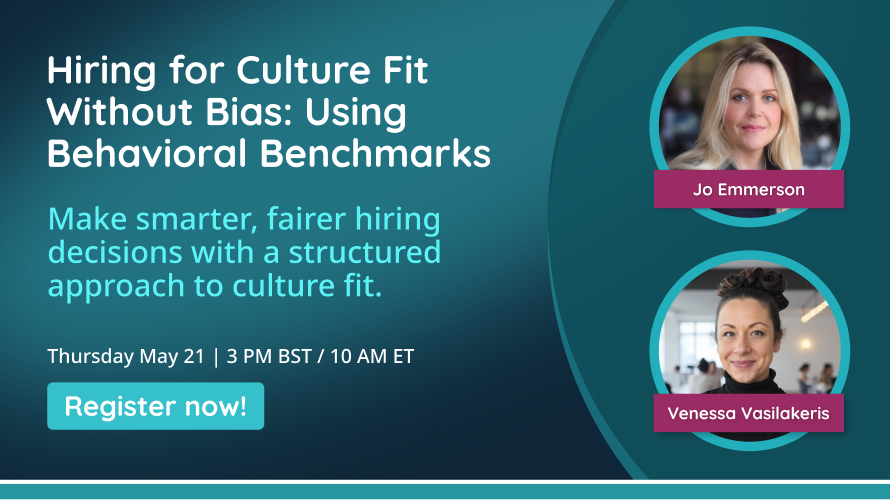
Join us for 'Hiring for Culture Fit Without Bias: Using Behavioral Benchmarks'
Want to take a more structured, fair approach to hiring for culture fit? Join our upcoming webinar to learn how to define clear behavioral benchmarks, reduce bias, and make more consistent hiring decisions. Save your spot and start building a hiring process that truly works.
* https://www.pin.com/blog/structured-interviews-guide